
What to Do
A booking website that displays carbon knows that older planes are fuel hogs. The carbon calculations done by the Travel Impact Model (TIM) show you the estimated emissions for each specific aircraft type. As you make comparisons, you’ll notice that an itinerary that uses an older plane comes with a higher carbon price tag.
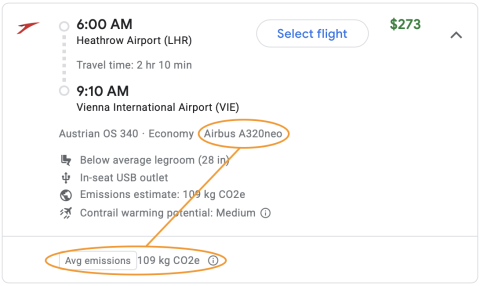
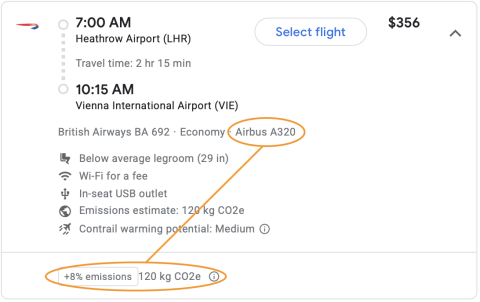
If you can, pick the itinerary with average or below-average emissions for your route. It’s one of the simplest ways to shrink your travel footprint—without canceling your trip or breaking your budget.
More tips and tricks for dramatically lowering your travel footprint here.*
Why it matters
Not all planes are created equal. Some are climate hogs, others are surprisingly efficient. In fact, aircraft design has come a long way in the past few decades:
Bigger, more efficient engines: Modern jet engines squeeze more miles out of every gallon of fuel.

Lightweight materials: Carbon-fiber parts make planes lighter, so they burn less fuel.
Winglets (those little upturned tips at the end of wings): They cut drag and boost efficiency.

Because of changes like these, newer aircraft such as the Boeing 737 Max and the Airbus A320neo are about 15–20% more efficient than their older cousins. Since the 1980s, overall aircraft efficiency has improved by about 36%.
Smaller isn’t always better. Regional jets (the ones with fewer than six seats across) tend to be less efficient per passenger than larger aircraft, even if they look more compact.