

What to do
Downgrade your seat choice from first to business, business to plus, or plus to economy. Perhaps instead of splurging on a premium seat for your journey, you could treat yourself to something on the ground either before or after the flight.
Here are some carbon estimates for different seat classes from Google Flights. All estimates are for the same flight on British Airways flight 284 from San Francisco to London Heathrow on January 30th 2026 and only differ by the cabin class. The lie flat seats of business and first class incur a carbon cost of 1.5 to 2 tons of carbon one way.
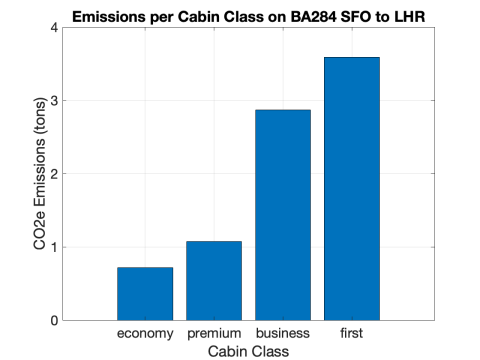
Here are the actual estimates from Google Flights and the Travel Impact Model
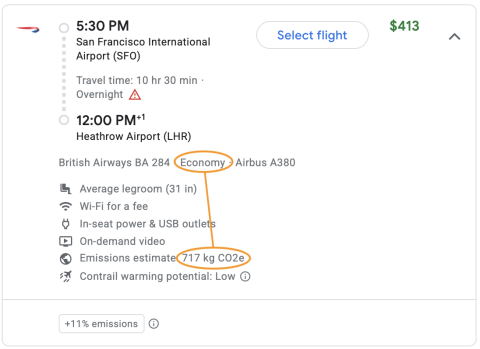
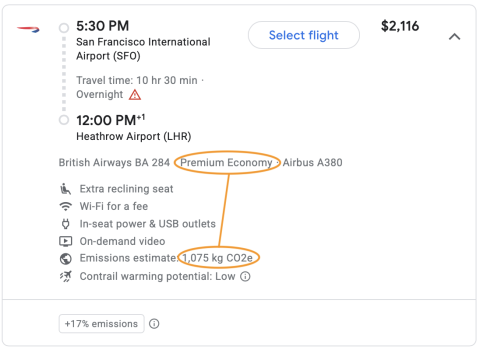
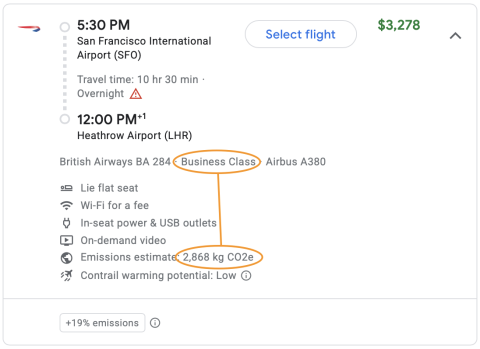
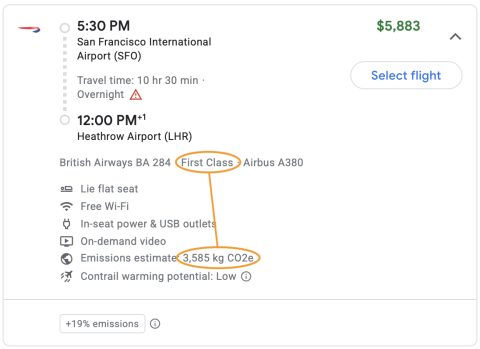
More tips and tricks for dramatically lowering your travel footprint here.
Why the difference
Extra weight demands extra fuel. Premium aircraft seats add a lot of weight to an aircraft. For example—In one instance, SwissAir added first-class seats that were so heavy that the aircraft became unbalanced. To keep the plane airworthy, Swiss Air had to add even more weight in the rear of the aircraft to balance the luxury up front. That extra useless weight caused the aircraft to consume even more fuel.
Extra space for premium seats means that fuel consumption per passenger becomes worse. For long-haul flights, 3 to 5 economy seats could fit in one first-class accommodation. Imagine filling an entire aircraft with first-class seats. In this configuration, per passenger fuel efficiency would be 66% to 80% worse than the same flight if it were filled entirely with economy seating.
Budget airlines have few, if any, premium class seats and the actual seats themselves are light. Because of this, budget airlines will typically emit less carbon for the same route.