

What to do
A booking website that displays carbon knows that, all else being equal, that direct routes are best. Weirdly enough this does not necessarily mean that non-stop is always best (see below). The carbon calculations done by the Travel Impact Model (TIM) on Google Flights account for routing distance. As you use a site like Google Flights to book you’ll notice that a more direct itinerary can save a lot of carbon.
If you can, pick the itinerary with average or below-average emissions for your route. It’s one of the simplest ways to shrink your travel footprint—without canceling your trip or breaking your budget.
More tips and tricks for dramatically lowering your travel footprint here.
Globe vs Map
The farther you fly to get somewhere the more fuel you use. To get your intuition of distance in sync with the results of Google Flights don't think of lines on a standard Mercator map, instead think of lines on a curved globe. FlyBetter shows you results on a globe to help cultivate this intuition.
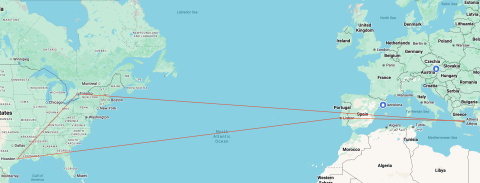
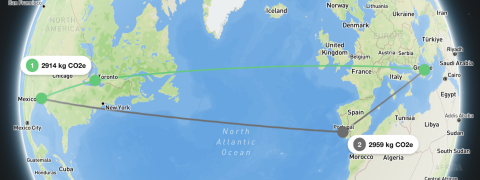
Consider two different one stop routes from Houston to Athens. One stops in Toronto and the other in Lisbon. On the standard map it looks like flying through Lisbon is shorter, but in fact flying through Toronto is shorter by 440 miles.
When Non-Stop Emits More
Although it might seem like direct and non-stop are equivalent they aren’t. Incredibly non-stop flights are not always the best option. Extremely long non-stop flights become less fuel efficient because the planes designed for these routes become more like fuel tankers than passenger planes. They’re carrying a lot of fuel just to be able to take off with and carry all the fuel needed to fly for such a long time. Here’s a good wiki page explaining the idea.
Even on shorter routes a one-stop itinerary can be surprisingly close in carbon to a non-stop flight. This is the case because much of the extra fuel an aircraft uses to get up to cruising altitude is then saved when it glides down for landing. So the extra take-off and landing of an added stop introduces a relatively small emissions difference that could be compensated for with a more efficient aircraft or more full aircraft.